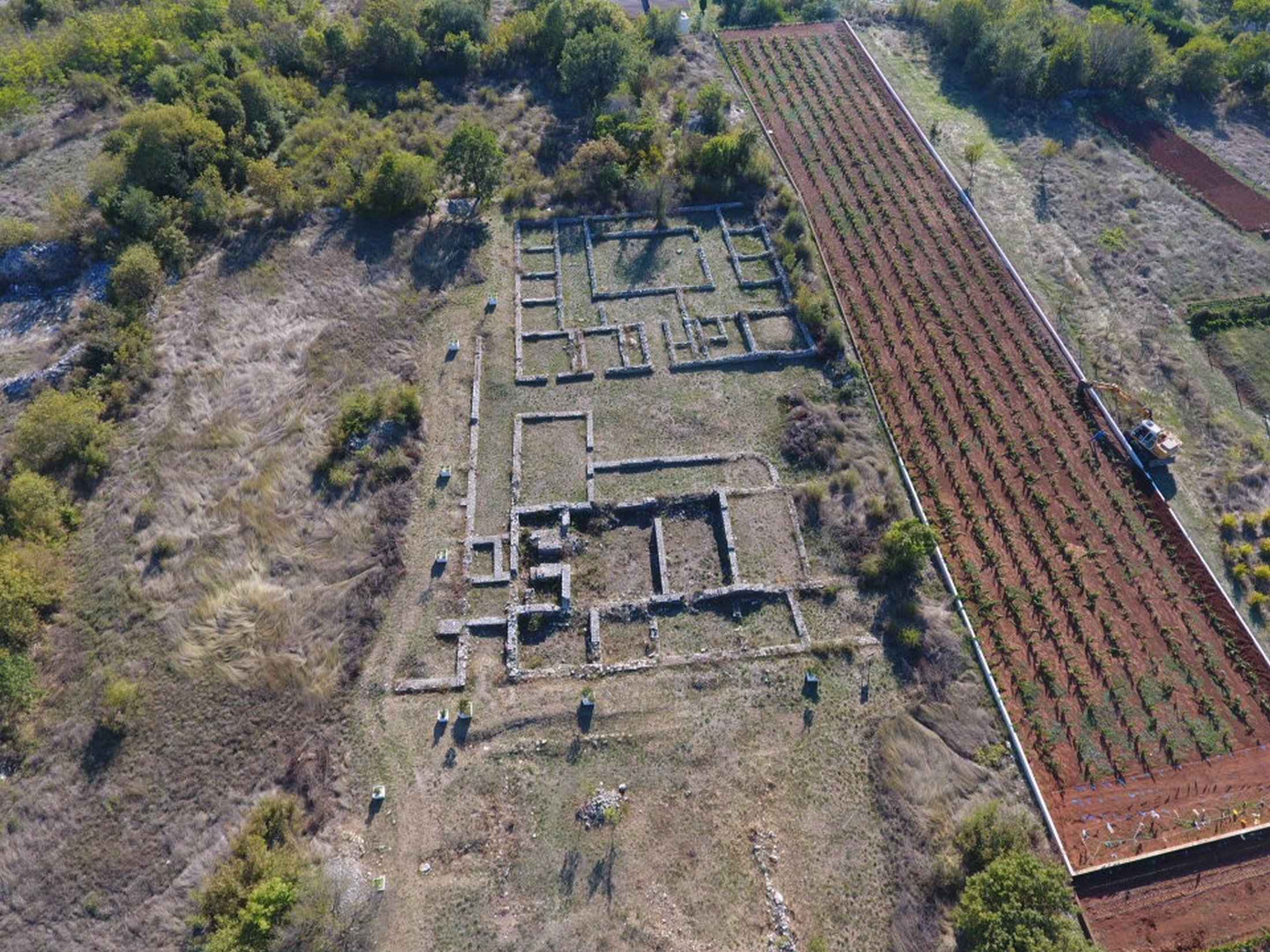
When in AD 9 they broke the resistance of the militant Illyrians, Delmatians and Pannonians, the Romans began to build roads, bridges and forts. One of the small military camps, which could accommodate a cohort of four hundred soldiers and a hundred horsemen, was situated in the area of Ljubuški. It is assumed that the camp was located at the site of Gračine in Humac. According to numismatic, metal and ceramic finds it was built in the 1st century, probably during the reign of Tiberius, when the road Salona—Narona was completed. Its role was primarily strategic and defensive—to protect the valley of the River Neretva and the area of the colony Narona from the intrusion of the Illyrian peoples from the hinterland. Only one part of the Roman complex was examined in an area of 2350 square meters. Material for the construction of the walls comes from the nearby quarries in Bijača, Hardomilij and Crveni Grm. The central part of the complex was the baths, mainly used by the military and civilian elite. Near the camp there were a lot of accompanying craftsmen — blacksmiths, hairdressers, shoemakers, stonemasons, gunsmiths, and probably a military brothel. In the complex itself several fragments of tiles with stamps of military units were found, so it is assumed that the legions and cohorts made roof tiles and bricks for construction in furnaces.
Leave a Reply